2025-03-26
Team Bunnies Statement
🔗 2025-03-26 Team Bunnies Statement
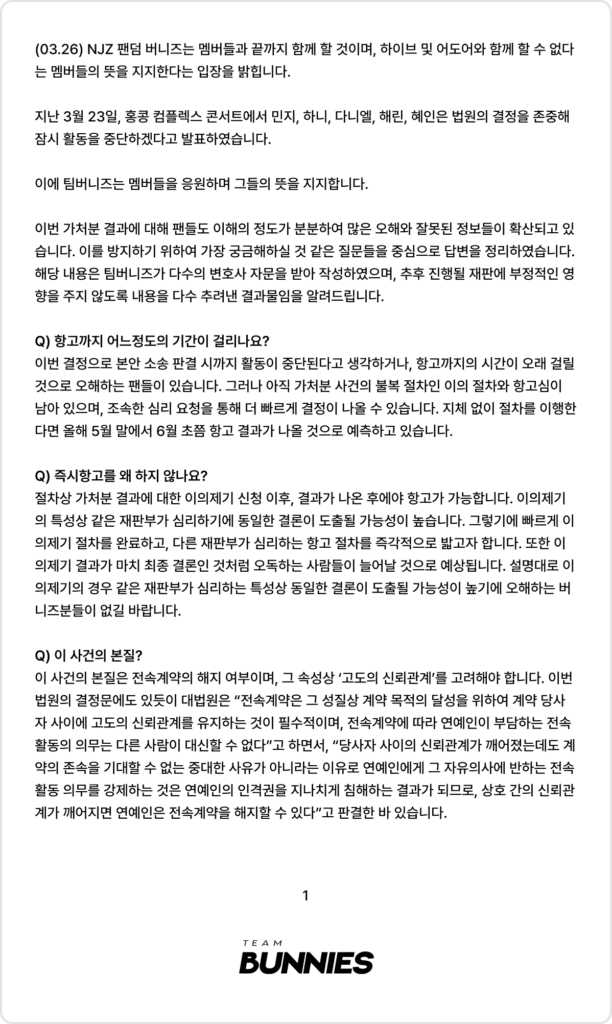
(03.26) We, the NJZ fandom Bunnies, hereby express our position that we will stand with the members until the end and that we support the members’ decision that they cannot continue with HYBE and ADOR.
On March 23, at the ComplexCon Hong Kong concert, Minji, Hanni, Danielle, Haerin, and Hyein announced that they would temporarily suspend their activities in respect of the court’s decision.
In response, Team Bunnies cheers on the members and supports their decision.
There has been a wide range of understanding among fans regarding the outcome of this injunction, leading to the spread of many misunderstandings and inaccurate information. To prevent this, we have compiled answers centered around questions that fans are most likely to have. This content was prepared by Team Bunnies with advice from multiple attorneys, and we would like to note that much of the content has been carefully filtered to avoid negatively affecting the upcoming trial.
Q) How long will it take until the appeal?
Some fans believe that this ruling suspends activities until a judgment is reached in the main lawsuit, or mistakenly think that the appeal process will take a long time. However, the objection procedure and the appeal—which are remedies against an injunction ruling—still remain, and a quicker decision can be reached by requesting expedited review. If procedures are carried out without delay, we anticipate that the appeal decision will be issued around late May to early June of this year.
Q) Why not file an immediate appeal?
Procedurally, an appeal can only be filed after filing an objection to the injunction ruling and receiving a decision on that objection. Due to the nature of the objection process, the same panel of judges reviews the case, making it highly likely that the same conclusion will be reached. Therefore, we plan to complete the objection procedure quickly and immediately proceed with the appeal, which will be reviewed by a different panel of judges. We also anticipate that some people will misinterpret the outcome of the objection as if it were the final conclusion. As explained, since the same panel of judges reviews objections, there is a high likelihood of the same conclusion being reached, so we hope Bunnies do not misunderstand this.
Q) The essence of this case?
The essence of this case is whether the exclusive contract can be terminated, and by its nature, “a high degree of mutual trust” must be considered. As stated in this court’s ruling, the Supreme Court has ruled that “exclusive contracts, by their nature, require maintaining a high degree of mutual trust between the contracting parties to achieve the contract’s purpose, and the obligation to perform exclusive activities that an entertainer bears under an exclusive contract cannot be fulfilled by another person,” and that “if the trust between the parties has broken down, forcing an entertainer to perform exclusive activities against their free will on the grounds that it does not constitute a significant reason making the continuation of the contract untenable would excessively violate the entertainer’s personal rights; therefore, when mutual trust has broken down, the entertainer may terminate the exclusive contract.”
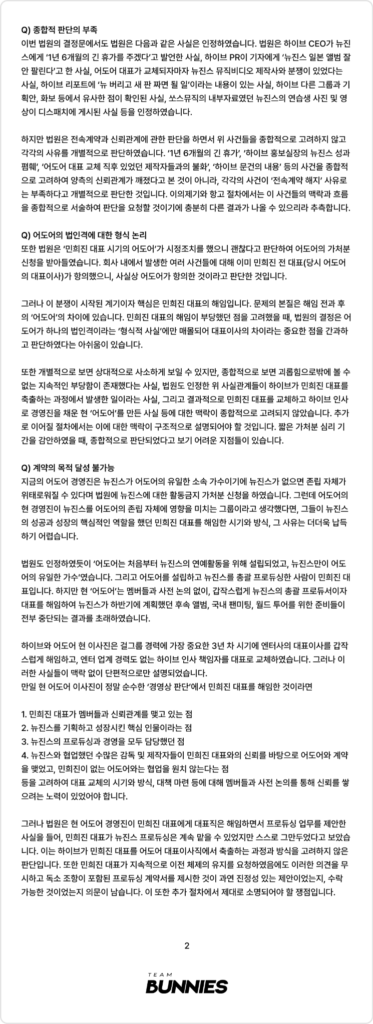
Q) Lack of comprehensive judgment
In this ruling, the court acknowledged the following facts: the court recognized that the HYBE CEO stated he would give NewJeans “an 18-month long vacation”; that HYBE’s PR team told a reporter that “NewJeans’ Japan album is not selling well”; that there was a dispute with NewJeans’ music video production company immediately after ADOR’s CEO was replaced; that a HYBE report contained the phrase “abandon ‘New’ and start fresh”; that similarities were found in concepts and photo shoots with other HYBE groups; and that NewJeans’ trainee photos and videos, which were internal materials of Source Music, were posted on Dispatch.
However, in making its judgment on the exclusive contract and the trust relationship, the court did not comprehensively consider these incidents together but evaluated each reason individually. Rather than comprehensively considering the “18-month long vacation,” “HYBE’s Head of PR disparaging NewJeans’ achievements,” “discord with producers immediately after ADOR’s CEO was replaced,” and “the contents of the HYBE document” to determine that trust between the two sides had broken down, the court individually judged that each incident was insufficient grounds for “termination of the exclusive contract.” In the objection and appeal procedures, we will request a judgment that comprehensively describes the context and flow of these incidents, and we believe this could lead to a different outcome.
Q) Formalistic reasoning regarding ADOR’s legal personality
Additionally, the court accepted ADOR’s injunction request, ruling that corrective measures were taken during “Min Hee-jin’s tenure as CEO of ADOR” and that this was sufficient. The court determined that since former CEO Min Hee-jin (who was ADOR’s CEO at the time) had already protested the various incidents within the company, it was effectively ADOR that had protested.
However, the trigger and core of this dispute is the dismissal of CEO Min Hee-jin. The essence of the problem lies in the difference between “ADOR” before and after her dismissal. Considering that CEO Min Hee-jin’s dismissal was unjust, it is regrettable that the court’s decision was confined to the “formal fact” that ADOR is a single legal entity and overlooked the crucial point of the difference in CEOs.
Furthermore, the following contexts were not comprehensively considered: the fact that while each incident may appear relatively minor when viewed individually, when viewed together they can only be seen as persistent mistreatment; the fact that the incidents acknowledged by the court occurred during HYBE’s process of ousting CEO Min Hee-jin; and the fact that this ultimately resulted in the current “ADOR”—with Min Hee-jin replaced and the management filled with HYBE personnel. These contexts must be structurally explained in the subsequent procedures. Given the short deliberation period for injunction proceedings, there are aspects that cannot be considered to have been comprehensively judged.
Q) Impossibility of achieving the contract’s purpose
The current ADOR management filed an injunction to prohibit NewJeans from engaging in activities, arguing that since NewJeans is ADOR’s only artist, ADOR’s very existence could be jeopardized without them. However, if the current ADOR management truly believed that NewJeans is a group that affects ADOR’s very existence, the timing and manner of their dismissal of CEO Min Hee-jin—who played a core role in NewJeans’ success and growth—and the reasons for doing so become even more difficult to understand.
As the court also acknowledged, “ADOR was established from the beginning for NewJeans’ entertainment activities, and NewJeans is ADOR’s only artist.” And it was CEO Min Hee-jin who founded ADOR and served as the Executive Producer for NewJeans. However, the current “ADOR” abruptly dismissed NewJeans’ Executive Producer and CEO without prior consultation with the members, resulting in the complete halt of preparations for the follow-up album, domestic fan meeting, and world tour that NewJeans had planned for the second half of the year.
HYBE and the current ADOR board of directors abruptly dismissed the entertainment company’s CEO during the third year—the most crucial period in a girl group’s career—and replaced her with a HYBE HR executive who had no experience in the entertainment industry. However, these facts were only explained in fragments without context. If the current ADOR board truly dismissed CEO Min Hee-jin based on a genuine “business judgment,” they should have made efforts to build trust through prior consultation with the members regarding the timing, manner, and contingency measures for the CEO change, considering:
1. CEO Min Hee-jin had a trust relationship with the members
2. She was the key figure who conceived and developed NewJeans
3. She was responsible for both producing and managing NewJeans
4. Numerous directors and producers who collaborated with NewJeans signed contracts with ADOR based on their trust in CEO Min Hee-jin, and they do not wish to work with an ADOR without Min Hee-jin
However, the court noted that the current ADOR management offered Min Hee-jin a producing role while dismissing her from the CEO position, and concluded that Min Hee-jin could have continued producing NewJeans but chose to resign on her own. This judgment fails to consider the process and manner in which HYBE ousted CEO Min Hee-jin from her position as ADOR’s CEO. Furthermore, questions remain as to whether it was a sincere proposal or something she could have accepted, given that CEO Min Hee-jin had continuously requested the maintenance of the previous system, yet her opinions were ignored and she was presented with a producing contract that included poison pill clauses. This is also an issue that must be properly addressed in subsequent procedures.
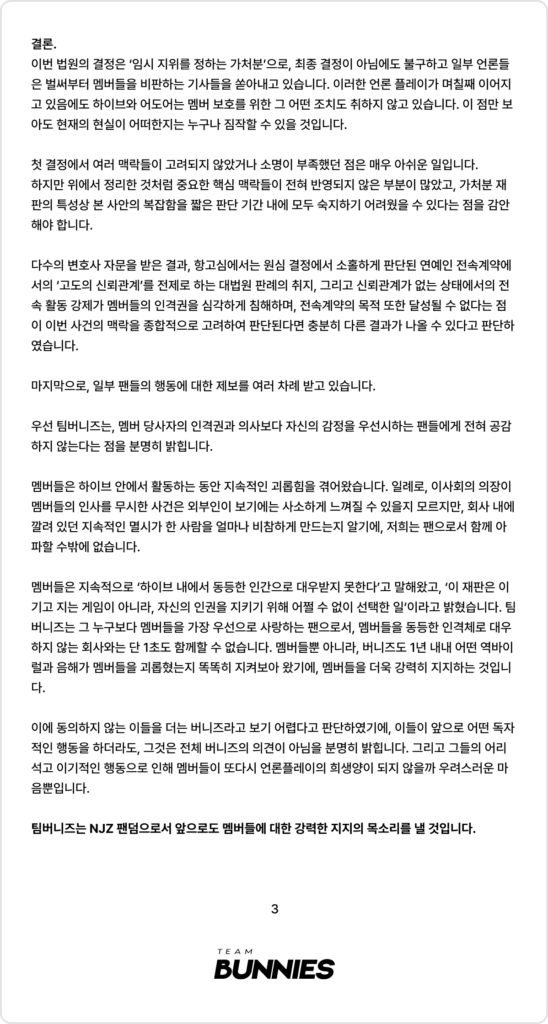
Conclusion.
This court decision is a “provisional disposition to determine temporary status,” and although it is not a final ruling, some media outlets have already been churning out articles criticizing the members. Despite this media play continuing for days, HYBE and ADOR have not taken any measures to protect the members. This alone should make it clear to anyone what the current reality looks like.
It is deeply regrettable that multiple contexts were not considered or that the evidence presented was insufficient in the initial ruling. However, as outlined above, many important core contexts were not reflected at all, and we must take into account that, given the nature of injunction proceedings, it may have been difficult for the court to fully grasp the complexity of this case within such a short deliberation period.
After consulting with multiple attorneys, we have concluded that the appeal could yield a different outcome if the following are comprehensively considered in light of the circumstances of this case: the Supreme Court precedent that “a high degree of mutual trust” is a prerequisite in exclusive entertainment contracts—an aspect that was insufficiently addressed in the original ruling—and the fact that forcing exclusive activities without such trust severely violates the members’ personal rights and renders the purpose of the exclusive contract unachievable.
Lastly, we have received multiple reports regarding the behavior of some fans.
First, Team Bunnies would like to make it clear that we have absolutely no sympathy for fans who prioritize their own emotions over the members’ personal rights and wishes.
The members have experienced ongoing mistreatment while working under HYBE. For example, an incident in which the Chairman of the Board of Directors ignored the members’ greetings may seem trivial to outsiders. However, we understand how devastating persistent contempt within a company can be to a person, and as fans, we cannot help but feel their pain.
The members have consistently stated that they “have not been treated as equals within HYBE,” and that “this lawsuit is not a game to win or lose, but a choice they had no option but to make in order to protect their human rights.” As fans who love the members more than anyone and put them first, Team Bunnies cannot stand by a company that does not treat the members as equals—not even for a single second. Furthermore, Bunnies have witnessed firsthand the negative viral campaigns and smears that have tormented the members throughout the past year, which is why we support the members even more strongly.
We have determined that those who do not agree with this can no longer be considered Bunnies. Therefore, we make it clear that any independent actions they may take in the future do not represent the views of Bunnies as a whole. We are also deeply concerned that their foolish and selfish behavior may once again make the members victims of media play.
Team Bunnies will continue to voice our strong support for the members as the NJZ fandom.