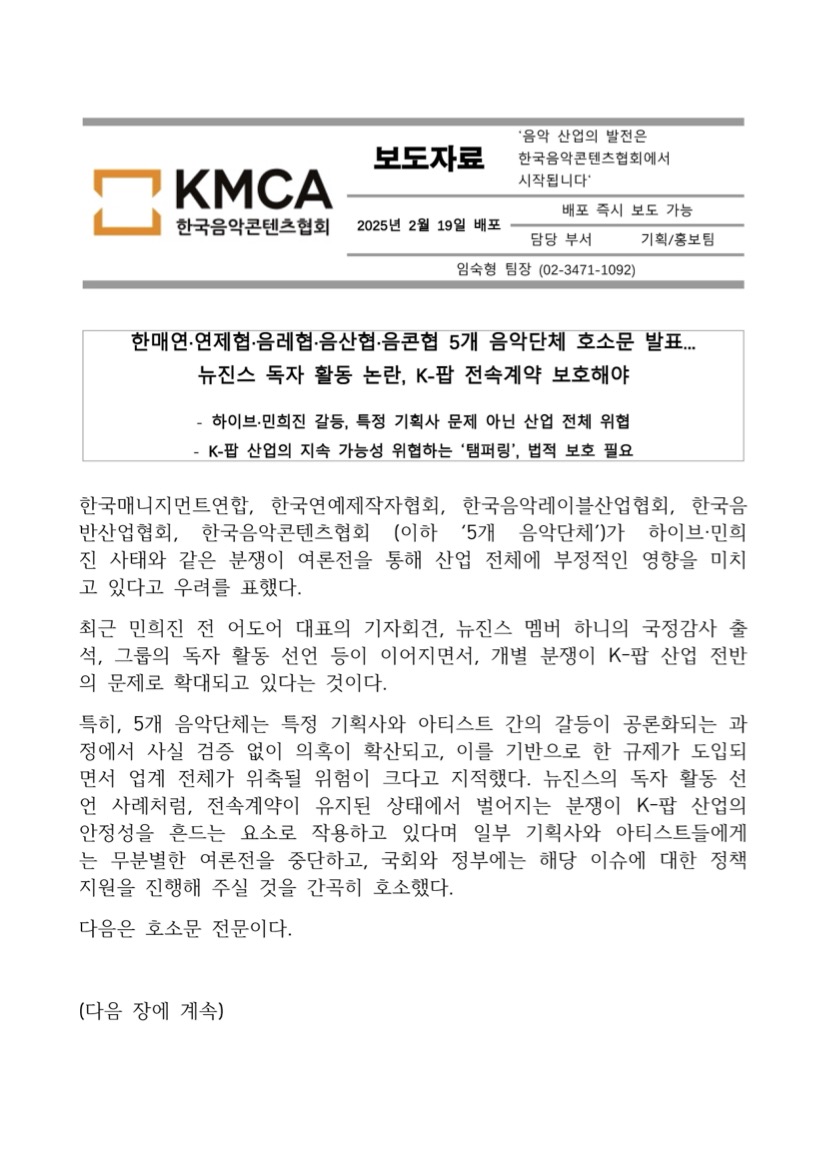
Five Major Music Industry Associations Release Appeal Calling for Anti-Tampering Law
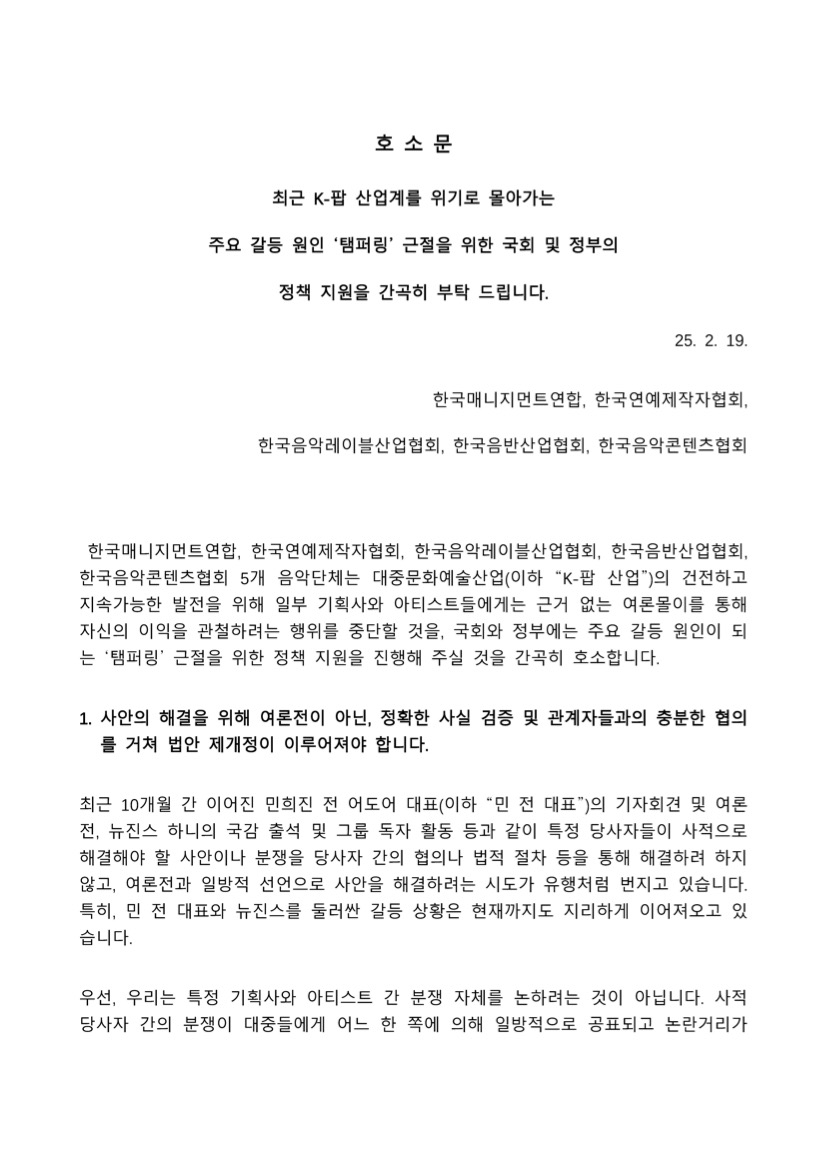
A P P E A L
We earnestly request policy support from the National Assembly and the government
to eradicate ‘tampering,’ a major cause of conflict
that is driving the K-pop industry into crisis.
February 19, 2025
Korea Management Federation, Korea Entertainment Producer’s Association,
Record Label Industry Association of Korea, Recording Industry Association of Korea, Korea Music Content Association
The five music organizations—Korea Management Federation, Korea Entertainment Producer’s Association, Record Label Industry Association of Korea, Recording Industry Association of Korea, and Korea Music Content Association—earnestly appeal to certain agencies and artists to cease their attempts to advance their interests through unfounded public opinion campaigns for the sound and sustainable development of the pop culture and arts industry (hereinafter “K-pop industry”), and to the National Assembly and the government to provide policy support to eradicate ‘tampering,’ a major cause of conflict.
1. To resolve this matter, legislation should be enacted or amended through accurate fact-finding and sufficient consultation with stakeholders, not through public opinion warfare.
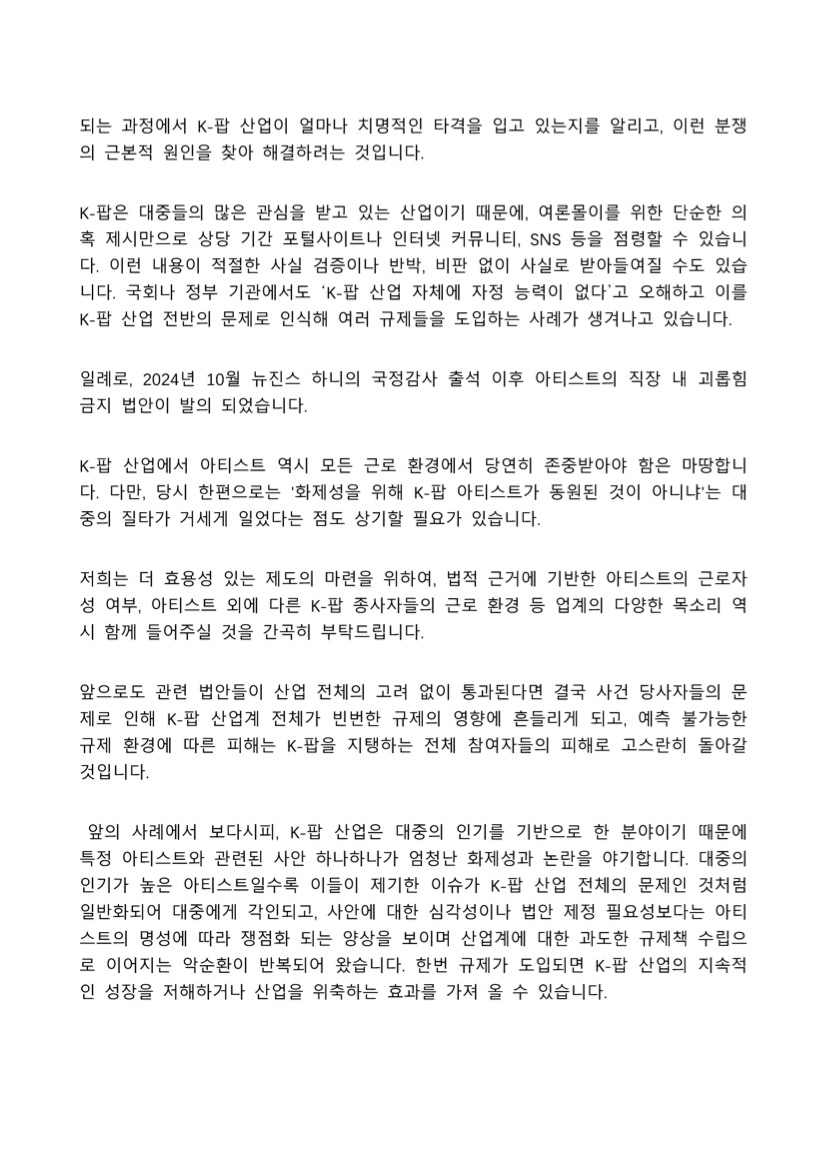
Over the past 10 months, we have seen press conferences and public opinion campaigns by former ADOR CEO Min Hee-jin (hereinafter “former CEO Min”), NewJeans’ Hanni’s appearance at the National Assembly audit, and the group’s independent activities. Private matters or disputes that specific parties should resolve privately are increasingly being addressed through public opinion campaigns and unilateral declarations rather than through negotiation between the parties or legal procedures—a trend that is spreading like a fad. In particular, the conflict surrounding former CEO Min and NewJeans has dragged on tediously to this day.
First, we are not attempting to discuss the dispute itself between a specific agency and artist. We aim to raise awareness of how devastating the damage to the K-pop industry has been as private disputes between parties have been unilaterally publicized to the public by one side and become controversial, and to find and address the root cause of such disputes.
Because K-pop is an industry that attracts significant public attention, the mere presentation of allegations for the purpose of swaying public opinion can dominate portal sites, online communities, and social media for considerable periods. Such content may be accepted as fact without proper verification, rebuttal, or criticism. The National Assembly and government agencies have also misunderstood that ‘the K-pop industry itself lacks the ability to self-regulate’ and perceived this as a problem for the entire K-pop industry, leading to cases where various regulations have been introduced.
For example, after NewJeans’ Hanni appeared at the National Assembly audit in October 2024, a bill prohibiting workplace harassment of artists was introduced.
It is only right that artists in the K-pop industry should be respected in all working environments. However, it should also be noted that at the time, there was significant public criticism questioning whether ‘a K-pop artist was being used for publicity purposes.’
To establish more effective systems, we earnestly request that you also listen to the various voices of the industry, including the legal basis for determining artists’ worker status and the working conditions of K-pop industry workers other than artists.
If related legislation continues to be passed without consideration for the entire industry, the entire K-pop industry will ultimately be destabilized by frequent regulations due to problems caused by the parties involved in specific incidents, and the damage from unpredictable regulatory environments will fall squarely on all participants who support K-pop.
As seen in the above example, because the K-pop industry is a field based on public popularity, each individual matter involving specific artists generates enormous publicity and controversy. The more popular an artist is, the more their issues become generalized and imprinted on the public as problems of the entire K-pop industry, and issues become politicized based on the artist’s fame rather than the seriousness of the matter or the necessity of legislation, leading to a vicious cycle of excessive regulatory measures for the industry. Once regulations are introduced, they can have the effect of hindering the sustained growth of the K-pop industry or causing the industry to contract.
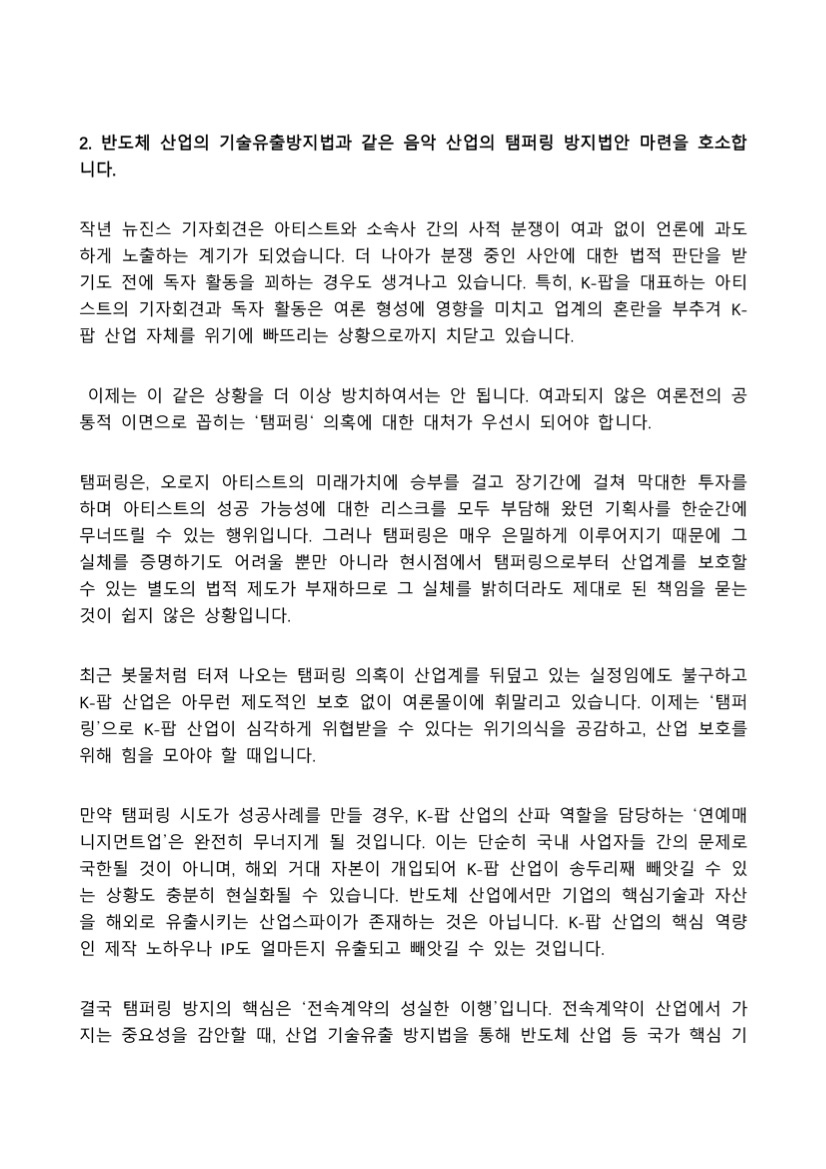
2. We appeal for the establishment of anti-tampering legislation for the music industry, similar to the technology leak prevention laws for the semiconductor industry.
Last year’s NewJeans press conference became an occasion for private disputes between artists and their agencies to be excessively exposed to the media without filter. Furthermore, cases are emerging where independent activities are pursued before even receiving legal judgment on matters in dispute. In particular, press conferences and independent activities by artists representing K-pop are influencing public opinion, fueling industry confusion, and driving the K-pop industry itself into crisis.
This situation can no longer be left unchecked. Priority must be given to addressing ‘tampering’ allegations, which are commonly cited as the underlying factor behind unfiltered public opinion campaigns.
Tampering is an act that can instantly bring down agencies that have taken on all the risks of an artist’s potential for success, betting solely on the artist’s future value and making massive investments over extended periods. However, because tampering is conducted in great secrecy, it is not only difficult to prove its occurrence, but there is currently no separate legal system to protect the industry from tampering, making it difficult to hold parties properly accountable even when tampering is uncovered.
Despite tampering allegations flooding and engulfing the industry recently, the K-pop industry is being swept up in public opinion campaigns without any institutional protection. It is now time to share a sense of crisis that ‘tampering’ can seriously threaten the K-pop industry and to unite our efforts to protect the industry.
If tampering attempts succeed in creating successful precedents, the ‘entertainment management industry,’ which serves as the midwife of the K-pop industry, will collapse completely. This will not be limited to a problem among domestic businesses; situations where foreign capital intervenes and the K-pop industry is taken over entirely are fully capable of becoming reality. Industrial spies who leak companies’ core technologies and assets overseas do not exist only in the semiconductor industry. The production know-how and IP that are the core capabilities of the K-pop industry can also be leaked and taken away.
Ultimately, the key to preventing tampering is ‘faithful performance of exclusive contracts.’ Given the importance of exclusive contracts in the industry, just as various institutional mechanisms have been established to protect national core technologies such as the semiconductor industry through industrial technology leak prevention laws, institutional support measures that identify the reality of tampering acts that undermine exclusive contracts and poach artists, and that create an atmosphere of faithful performance of exclusive contracts, will definitely be necessary.
There is also a need to raise artists’ own awareness through various institutional mechanisms. In the case of NewJeans, who are currently engaging in independent activities without their contracts with their current agency being legally terminated, they recently announced a new activity name and publicly declared that they have ‘a new agent.’ If contracts are not legally protected and are broken by unilateral declaration, the K-pop industry will lose the foundation for its existence.
We once again earnestly ask the National Assembly and the government not to think of disputes or controversies related to tampering as simply conflicts among industry stakeholders, but to recognize them as a very significant risk to the K-pop industry, one of the core industries representing the Republic of Korea.
Until now, the K-pop industry has wisely overcome numerous obstacles, such as the illegal download market in the early 2000s and the pandemic in the 2020s, and turned crises into opportunities for growth. We earnestly appeal for the interest and support of the National Assembly, the government, and all sectors of society so that 2025 can be a year when K-pop, faced with the crisis of mutual destruction due to internal division, can overcome the crisis through harmony and communication and leap forward as Korea’s proud cultural industry. We will also do our best.
*Note: The coalition is an organization composed of non-profit corporations for the sound development of the K-pop industry, and this appeal has been prepared for public interest purposes.*